
Your Antivirus Is Not Enough: Why Modern Organizations Need EDR
Antivirus can block many threats, but it cannot always show what happened after an attack. Learn how EDR helps businesses detect, investigate, and respond to security incidents.
Many organizations assume antivirus is enough because it successfully blocks most threats they encounter. The problem usually isn't the threats that get blocked. It's the ones that slip through unnoticed.
As organizations become more cloud-connected, remote, and distributed, security teams increasingly need more than prevention. They need visibility into what happened, what else was affected, and how to respond and improve.
That's where Endpoint Detection and Response (EDR) enters the conversation.
The Short Answer
Antivirus is often enough to block threats, but not enough to understand them. Modern endpoint protection stops a wide range of attacks. The gap appears when something slips through and your team has to answer: what happened, which user and commands were involved, did it spread, and is it still active?
That is what EDR is built for. It adds continuous endpoint visibility for investigation, threat hunting, and targeted response.
This is not antivirus versus EDR. The real question is whether your organization can understand what happens after something suspicious appears, before it's too late.
Antivirus vs. EDR: What's the Difference?
| Capability | Modern Antivirus | EDR |
|---|---|---|
| Block known malware | Yes | Yes |
| Behavioral detection | Often Yes | Yes |
| Process and command-line visibility | Limited | Yes - Detailed |
| Investigation timeline | No | Yes |
| Threat hunting | No | Yes |
| Endpoint isolation | No | Yes |
| Historical endpoint telemetry | No | Yes |
| Incident-response context | Limited | Yes - Detailed |
The detail varies by product, but the distinction is useful: modern antivirus focuses on stopping threats, while EDR provides the context and response capabilities needed to investigate suspicious activity.
Modern Antivirus Is More Capable Than Many People Think
When people hear the word “antivirus,” they often picture the old model:
Find a malicious file → match its signature → block it.
Modern endpoint protection goes much further. Today's products can analyze behavior, reputation, cloud intelligence, and other signals. This article is not arguing that modern antivirus relies only on signatures.
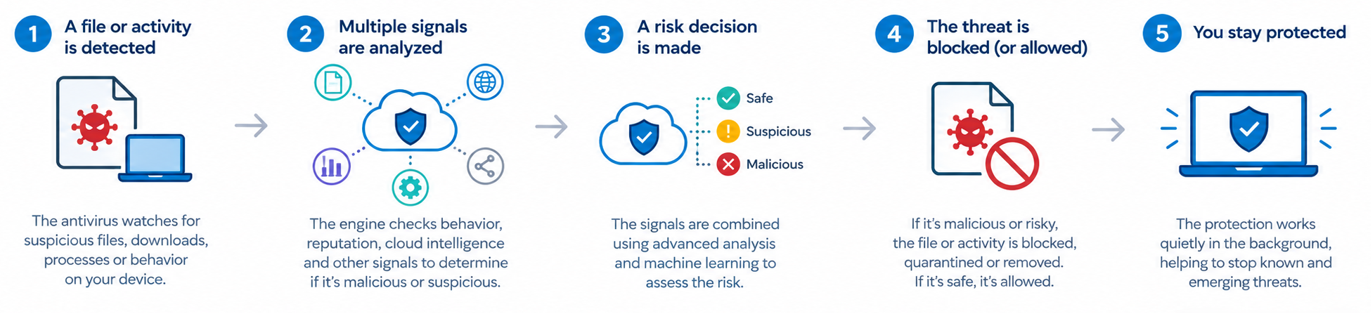
The gap appears when threat actors work around those mechanisms. They may abuse trusted software, slowly exfiltrate data through services such as Dropbox, or establish command-and-control traffic over HTTPS so it blends in with normal web activity. Some are willing to stay quiet for months simply to maintain access.
The more useful distinction is between preventing and detecting a threat and investigating the activity surrounding it. That is where EDR changes the picture.
The Problem Is Not Always a Malicious File
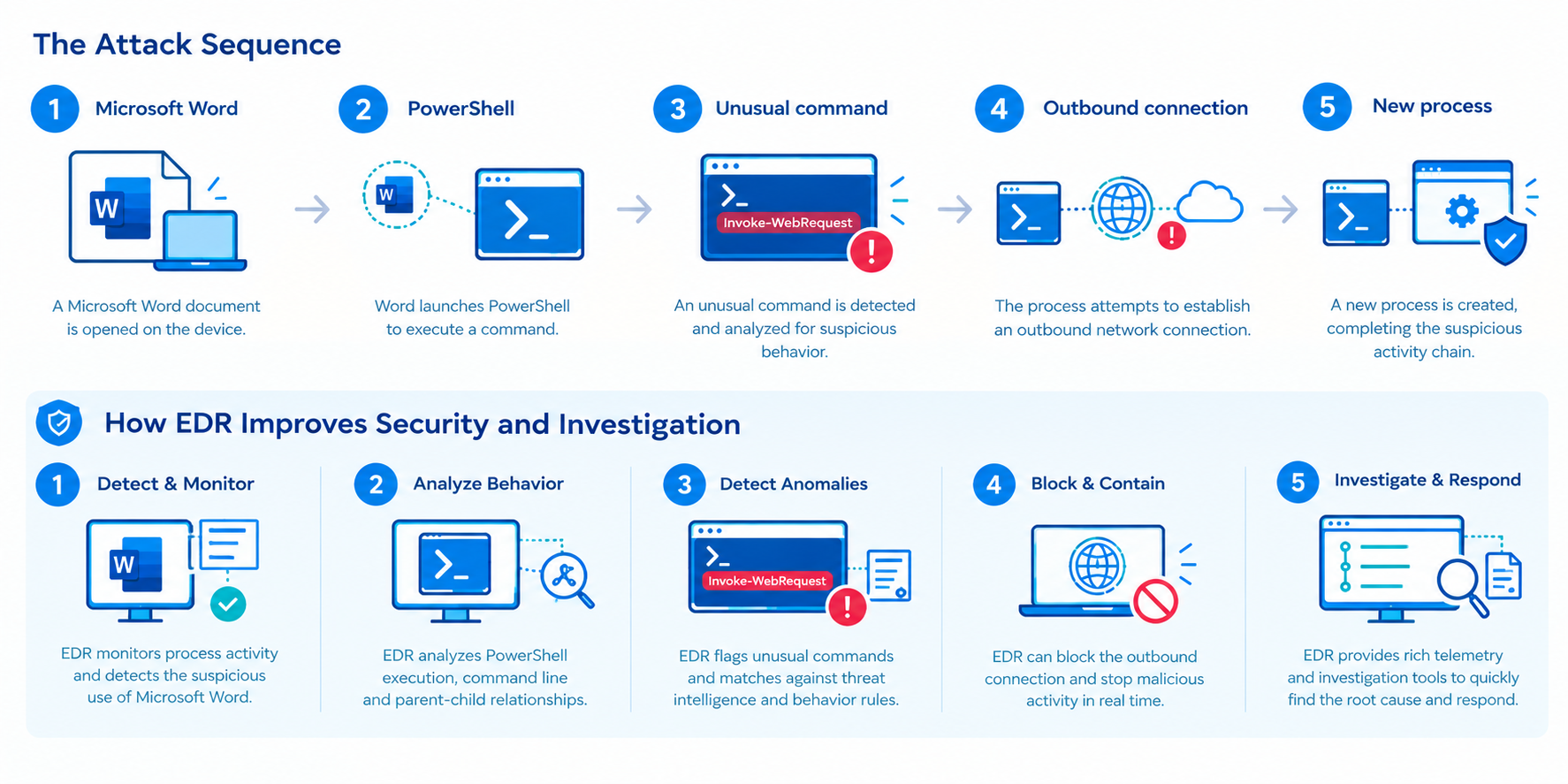
Picture a Windows endpoint that appears completely normal. A user opens a Microsoft Word document. Word launches PowerShell. PowerShell executes a command. The machine establishes an outbound connection. Shortly afterward, another process starts running.
Which part of that sequence is automatically malicious?
- Microsoft Word is not malicious.
- PowerShell is not malicious.
- Creating a process is not malicious.
- An outbound connection does not automatically mean malicious activity either.
But the relationship between those events may tell a very different story.
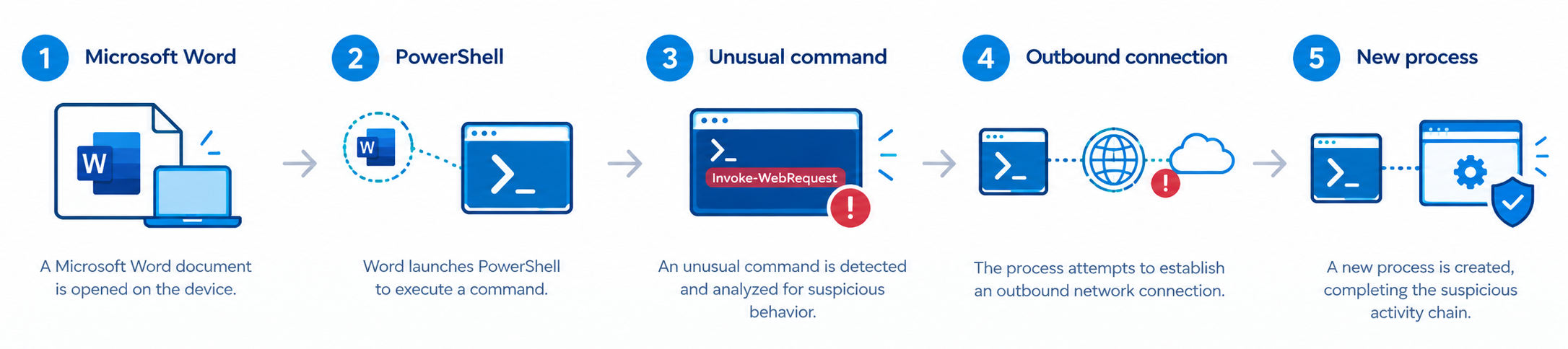 None of these actions is necessarily malicious on its own. The sequence of events as a whole, and the relationship between them, however, is worth investigating.
This is a common challenge with Living Off the Land Binaries , or LOLBins. Threat actor abuse trusted built-in system tools and operating-system functionality rather than relying on an executable that is obviously malicious. Each event may look normal in isolation. The chain tells a different story.
This Is Where EDR Changes the Picture
EDR gives security teams a deeper view of activity on an endpoint. Instead of reviewing only the latest detection, a security analyst can investigate the events surrounding it.
Depending on the platform, that may include process relationships, command-line activity, user context, network connections, file activity, registry changes, and other endpoint telemetry. The value is not simply the amount of data. The value is context.
Compare these two alerts:
PowerShell was executed
OR
Microsoft Word launched PowerShell, which ran an unusual command, followed by an outbound connection and the creation of another process.
The second alert gives a security analyst a much stronger reason to investigate. EDR is valuable because it helps security teams understand how individual events relate to one another.
 Quick Test: Is EDR Worth Considering?
Check how many of these apply to your organization:
- You need to investigate suspicious activity after an alert.
- mployees regularly work remotely.
- Sensitive business or customer data is stored on employee devices.
- You need to know whether multiple devices were affected by the same incident.
- Your team would struggle to reconstruct what happened after a compromise.
- You want the ability to isolate a device remotely during an investigation.
- You have cyber-insurance, compliance, or audit requirements that require deeper visibility.
If several of these sound familiar, EDR is probably what you need.
Does Every Organization Need EDR?
This is where we should avoid the answer security product vendors often give: “Yes. Every organization needs EDR.”
The reality is not that simple.
EDR can provide valuable capabilities, but it also introduces operational requirements. Someone must investigate the telemetry, respond to alerts, separate legitimate activity from real threats, and maintain detection rules and response procedures.
If an organization deploys EDR without the people, processes, or service needed to operate it, the technology will not solve the underlying problem. It may become an expensive dashboard that nobody uses effectively.
For some organizations, the answer is to build security operations internally. For others, an MDR service or security provider is more realistic.
Instead of asking only “Do we need EDR?”, ask:
“If one of our endpoints were compromised today, could we see what happened and respond quickly?”
That answer gives you a clearer view of the real security gap than simply checking whether a particular product is in place.
When Does EDR Start to Make Sense?
There is no device count or employee threshold that automatically makes EDR necessary. The decision depends on the risks you face, how your team works, and how prepared you are to respond to an incident.
EDR becomes more relevant when your organization needs to:
- Investigate suspicious activity on an employee device in greater depth.
- Understand a sequence of events rather than a single alert in isolation.
- Hunt for signs of threats before they become larger incidents.
- Investigate remotely without physically accessing the affected device.
- Determine whether other endpoints were affected by the same threat.
- Isolate a compromised device quickly to limit spread.
- Retain endpoint activity records for investigation and incident response.
The need also grows as organizations adopt more cloud services, support remote work, manage privileged access, and distribute devices across multiple locations.
Buying EDR and having the capability to detect and respond effectively are two different things. The latter requires people and processes, not just software.
One Honest Caveat: Visibility Creates Responsibility
More visibility also means more information to review.
EDR platforms can generate significant amount of telemetry. Without clear ownership, proper alert tuning, and a response process, an organization can end up with another dashboard without improving its security operations.
That is why the question isn't only “Which EDR platform should we choose?” It is also:
“Who will monitor it, investigate what it finds, and respond when something happens?”
For organizations without a dedicated security team, a managed security service can be part of the answer.
So, Is Antivirus Really Enough?
It depends on what you expect from your endpoint security.
For preventing and detecting threats, modern endpoint protection is already highly capable. But when you need to understand what happened during an incident, investigate suspicious activity, and respond to a compromised device, prevention alone is not enough.
That's where EDR adds value. Not because antivirus has stopped working, and not because every organization automatically needs another product. Detecting a threat and understanding an incident are two different problems.
When an incident occurs, the important question often is not “Did we detect something?” It is “Can we understand what happened?”
Stopping a threat matters. Understanding what happened afterward, confirming it is contained, and ensuring it is not simply quiet can be just as important. That is where endpoint protection and EDR complement each other.
Questions to Ask Before You Buy
Before comparing vendors, dashboards, and feature lists, start with a simpler question:
“If something suspicious happens on one of our endpoints, what can we actually see?”
- Can you reconstruct the sequence of events?
- Can you determine which user, process, and command were involved?
- Can you check whether other devices were affected?
- Can you investigate the endpoint remotely?
- Can you isolate the device quickly if necessary?
If those questions are difficult to answer, the gap may not be another antivirus engine. It may be a gap in endpoint visibility and response, which is exactly what EDR is designed to address.
How CloudNow Can Help
Closing the gap between detecting a threat and understanding an incident is not something you have to solve on your own.
CloudNow focuses on the Microsoft security ecosystem, from Microsoft Defender to Microsoft Sentinel, helping organizations improve the visibility and response capabilities that endpoint protection alone may not provide.
If you are not sure how prepared your organization would be if an endpoint were compromised today, a conversation with a CloudNow security specialist can help you understand the gaps, assess whether EDR or MDR fits your environment, and define a practical next step.